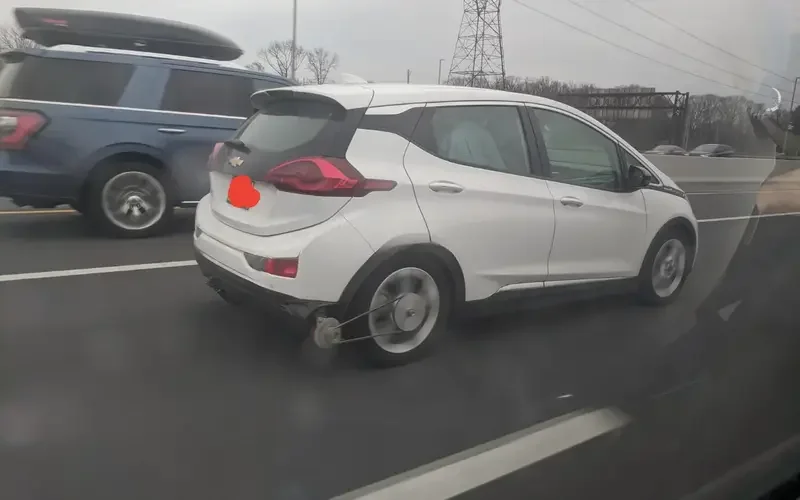
A Chevrolet Bolt fitted with a belt-driven generator attached to its rear wheel has gone viral on social media, sparking widespread debate and curiosity about whether the setup could generate extra power for the electric vehicle. Images and videos of the modified car led some viewers to speculate that the generator could recharge the battery while the vehicle is in motion, effectively creating a form of “free energy.”
Engineers and automotive experts, however, have pushed back strongly against these claims, explaining that such a system cannot produce free or surplus power. According to basic principles of physics, any generator driven by a wheel must draw its energy from the vehicle’s motion. This creates additional resistance, meaning the electric motor has to work harder and consume more battery power to keep the car moving at the same speed.
Experts note that while the generator may indeed produce electricity, the energy it generates would be less than the extra energy consumed due to mechanical losses, including friction in the belt, inefficiencies in the generator itself, and additional drag on the drivetrain. As a result, the setup would likely reduce overall efficiency and driving range rather than extend it.
Some engineers suggest the modification may have been designed as an experimental demonstration, a misunderstanding of energy conservation, or even a novelty project rather than a serious attempt to improve vehicle performance. Modern electric vehicles already recover energy through regenerative braking, which captures kinetic energy during deceleration more efficiently than any constant wheel-driven generator could.
In practice, experts say adding such a device would almost certainly waste more power than it saves, reinforcing the long-standing engineering reality that there is no way to bypass energy losses or create perpetual motion using onboard generators.