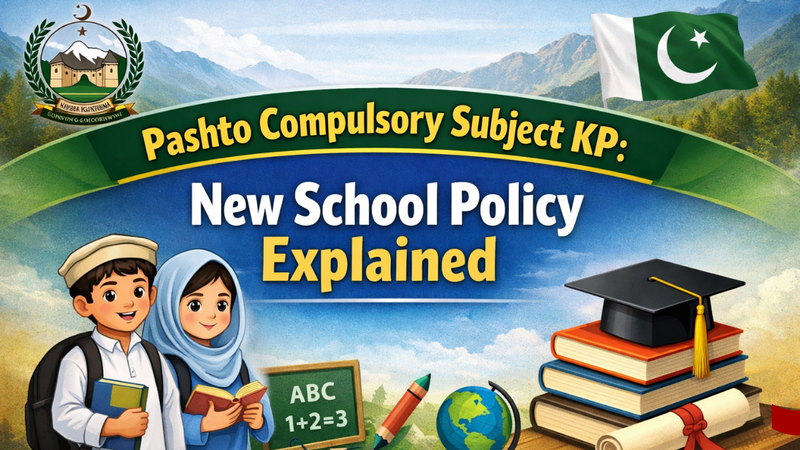
Pashto Compulsory Subject KP has been officially announced by the Khyber Pakhtunkhwa government, marking an important development in regional language education across the province. The Office of the District Education Officer (Male), Nowshera, has issued a formal directive instructing all government schools to ensure the teaching of Pashto up to the second year. This decision reinforces the provincial education policy aimed at preserving local languages while strengthening cultural identity among students.
The move to make Pashto a compulsory subject reflects KP’s long-standing commitment to promoting regional languages within the formal education system. Education authorities believe that learning Pashto helps students communicate more effectively within their communities and develop a stronger connection with their cultural roots. Officials have emphasized that language education is not limited to communication alone, but also plays a vital role in cognitive development, comprehension skills, and overall academic growth. By mandating Pashto, the province aims to balance modern academic requirements with cultural literacy.
According to the official notice issued by the District Education Officer (Male), Nowshera, the directive applies to all government high, middle, and elementary schools. The notice was addressed to principals and headmasters of government high schools and middle schools, as well as Sub-Divisional Education Officers in Pabbi, Nowshera, and Jahangira. It also referenced earlier instructions from the Elementary and Secondary Education Department, making it clear that the implementation of Pashto as a subject is mandatory across the province rather than optional or district-specific.
The directive clearly outlines that Pashto must be taught in all eligible classes up to the second year, with schools required to strictly follow the prescribed curriculum. School administrations are instructed to monitor teaching quality, maintain proper academic records, and track student performance in the subject. The notice also warns that failure to comply with these instructions could lead to accountability measures against heads of institutions and concerned education officials, highlighting the seriousness of enforcement.
School principals and headmasters now carry the primary responsibility for implementing this policy at the institutional level. They are required to integrate Pashto into lesson plans, assign qualified teachers, ensure regular classes are conducted, and report any issues or shortages to the education authorities. Effective coordination between school leadership and teaching staff is considered essential for smooth implementation. Non-compliance may result in administrative action, reinforcing the government’s intent to ensure uniform enforcement.
Teachers play a central role in the success of Pashto Compulsory Subject KP. They are expected to follow the approved syllabus, conduct regular assessments, and use engaging teaching methods that reflect local culture and daily usage of the language. Interactive learning approaches are encouraged to help students gain fluency, comprehension, and confidence in Pashto. Proper assessment methods will also help education authorities evaluate how effectively the subject is being taught across schools.
Introducing Pashto as a compulsory subject offers multiple educational and social benefits. Teaching the mother tongue helps students better understand concepts, improves literacy skills, and supports overall academic performance. It also strengthens cultural identity and instills pride in regional heritage. Students who are fluent in Pashto are better equipped to participate in community life, understand local literature and history, and contribute positively to social cohesion within the province.
Despite its advantages, the implementation of Pashto Compulsory Subject KP may face certain challenges. Some areas may experience a shortage of trained Pashto teachers, while others may lack adequate teaching materials and textbooks. Schools already struggling with curriculum load may also find it difficult to adapt quickly. To address these issues, the government may need to invest further in teacher training programs, curriculum development, and continuous monitoring to ensure consistency across districts.
Although Pashto has been included in KP’s curriculum in the past, enforcement remained uneven in many areas. This latest directive signals a shift toward stricter implementation and accountability. By standardizing Pashto education across government schools, the authorities aim to eliminate disparities, strengthen language instruction, and reaffirm their commitment to regional language promotion as part of the broader education strategy.
For students, this policy means regular and structured learning of Pashto up to the second year, leading to improved literacy in their native language and a deeper understanding of cultural traditions. Parents and guardians are encouraged to support their children’s learning at home, as family involvement can significantly enhance language acquisition and confidence.
Overall, the decision to enforce Pashto Compulsory Subject KP represents a meaningful step toward inclusive and culturally grounded education. By combining academic goals with cultural preservation and holding institutions accountable, the Khyber Pakhtunkhwa government aims to ensure that Pashto becomes a strong and lasting component of the province’s educational framework.