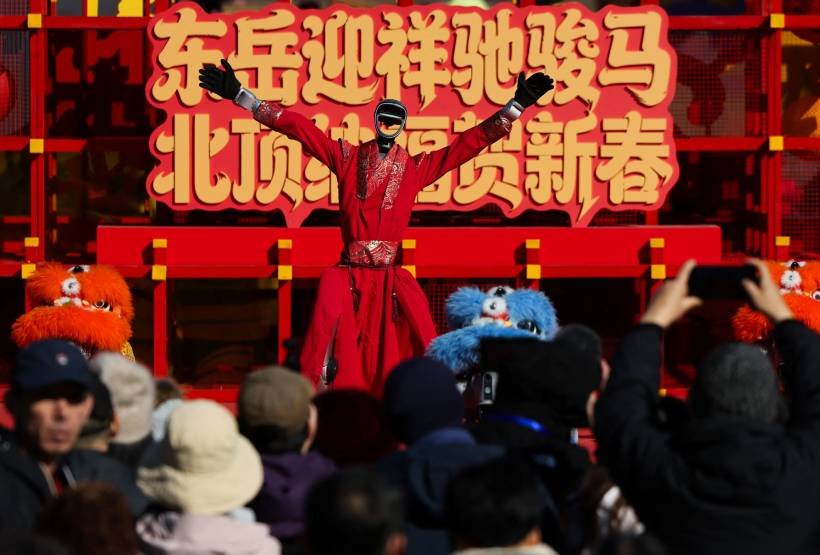
China’s annual Spring Festival gala aired by China Central Television has once again become a high-profile platform for showcasing the country’s advances in artificial intelligence, humanoid robotics, and next-generation manufacturing. The televised Lunar New Year event, often compared in cultural impact to the Super Bowl in the United States, highlighted Beijing’s industrial policy focus on automation and embodied AI.
This year’s broadcast prominently featured four emerging humanoid robotics firms — Unitree Robotics, Galbot, Noetix, and MagicLab — as they demonstrated advanced motion control, multi-robot coordination, and AI-powered performance capabilities. In one segment, more than a dozen humanoid robots performed complex martial arts routines, including sword and staff choreography inspired by traditional “drunken boxing,” illustrating progress in balance recovery and synchronized movement.
Artificial intelligence tools were also featured, including ByteDance’s chatbot Doubao, which appeared in the opening sketch. Other segments showed humanoid robots participating in synchronized dance routines and comedy performances alongside human actors, reinforcing the narrative of AI-human collaboration in future industries.
The robotics spotlight comes as several Chinese humanoid robotics companies prepare for potential initial public offerings and as domestic AI firms unveil new frontier models during the Lunar New Year period. Last year’s gala similarly generated attention when 16 full-sized humanoids from Unitree performed in coordinated dance routines, signaling rapid development in embodied AI systems.
China’s leadership has given the robotics sector notable visibility. President Xi Jinping has met multiple robotics startup founders over the past year, reflecting strategic support comparable to engagements with electric vehicle and semiconductor entrepreneurs. Analysts say the gala functions as a direct bridge between industrial policy and public spectacle, often translating into increased government contracts, investor interest, and market access for featured companies.
Behind the performances, China is positioning robotics and AI at the center of its AI-plus-manufacturing strategy. Policymakers view humanoid robots as a convergence of national strengths in AI software, advanced hardware supply chains, and large-scale manufacturing capability. Automation is also seen as a way to offset economic pressures from an aging population and labor shortages.
According to research firm Omdia, China accounted for roughly 90 percent of the estimated 13,000 humanoid robots shipped globally last year, outpacing U.S. competitors such as Tesla and its Optimus humanoid project. Morgan Stanley projects that China’s humanoid robot shipments could exceed 28,000 units this year, more than doubling year-on-year.
Tesla CEO Elon Musk has acknowledged that Chinese firms are likely to be his company’s strongest competitors as it pivots toward embodied AI and advanced robotics. The rapid performance improvements seen in Chinese humanoid demonstrations suggest that competition in the sector is intensifying, with AI-driven robotics emerging as a central arena in global technology rivalry.